
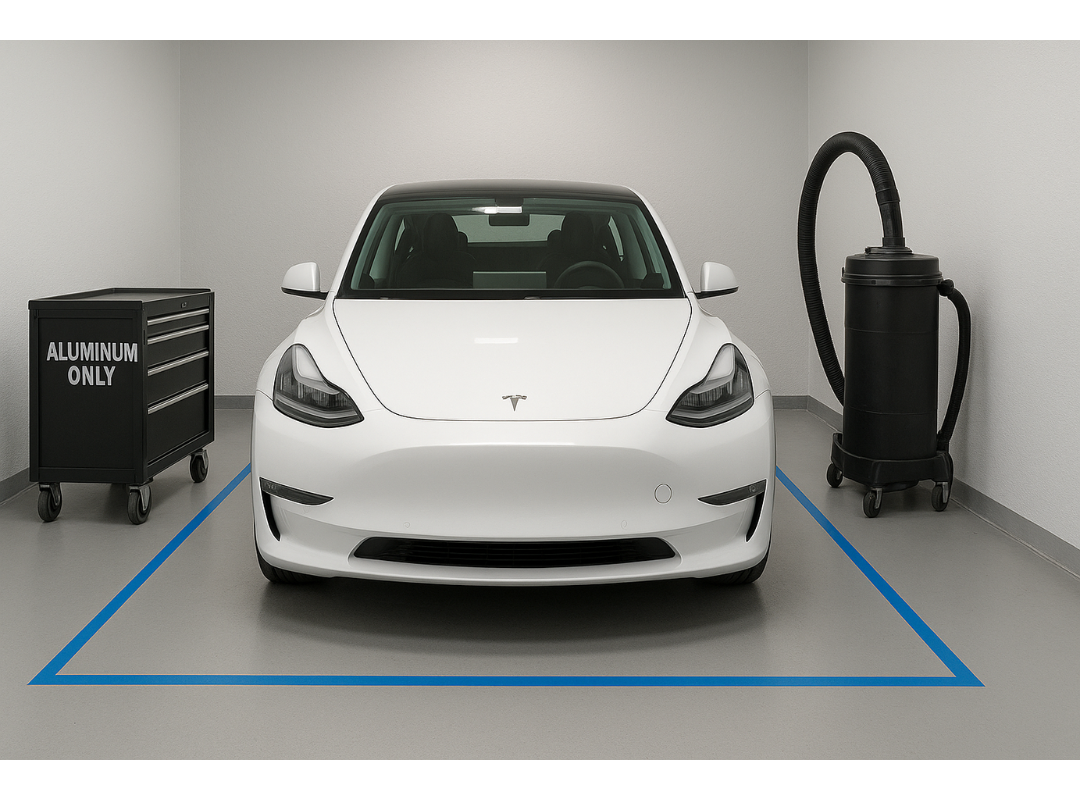
Own a Tesla or another aluminum-bodied vehicle in Walnut Creek? Repairing it isn’t the same as repairing steel. Aluminum panels, high-voltage (HV) systems, and advanced driver-assistance systems (ADAS) require specialized tools, clean isolation, and factory-informed procedures—or you risk fit issues, corrosion, or sensor glitches down the road.
Start local: Book a photo review or estimate at Husteads – Walnut Creek. Want the full picture first? See Our Process and Collision Repair Services.
At-a-glance: what’s different with Tesla & aluminum repair
- Metal behavior: Aluminum work-hardens and doesn’t “spring back” like mild steel, so technicians rely on aluminum-specific tools and techniques—the approach taught in I-CAR’s aluminum training.
- Clean isolation: Cross-contamination from steel dust can trigger galvanic corrosion under paint; best practice is a separate aluminum bay with dedicated tools and dust extraction (standard collision guidance covered by I-CAR RTS).
- Modern joining: Instead of only welding, OEM procedures often specify rivet bonding, structural adhesives, and MIG brazing—topics you’ll see across I-CAR’s joining courses.
- ADAS everywhere: Bumpers, fenders, and windshields can house sensors; NHTSA’s driver-assistance overview explains why scans and calibrations are critical after body work.
- EV safety: Technicians follow high-voltage disable and battery-protection procedures; NHTSA’s EV safety page outlines why this matters during collision repair.
Why aluminum needs aluminum-only tools (and a clean bay)
Using the wrong equipment creates real risks:
- Corrosion risk: Steel particles on an aluminum panel can set up dissimilar-metal corrosion after refinish. Clean, isolated work zones are considered best practice in professional guidance (see I-CAR RTS).
- Panel distortion: Dollies or pullers that are set up for steel can over-stretch aluminum, causing “oil canning.”
- Weak joints: Generic fasteners/adhesives can compromise crash performance—OEM procedures commonly mandate self-piercing rivets (SPR) and structural adhesives (covered in I-CAR’s joining curriculum).
- Dust management: Aluminum dust must be controlled; facilities follow combustible-metal housekeeping guidance referenced in codes like eCFR 29 CFR 1910 (combustible dust context) and NFPA resources.
How we handle it in Walnut Creek: a dedicated aluminum tool cart, a taped-off aluminum bay, and capture dust extraction—then spectro color-match and a controlled spray environment for invisible blends. (Peek our flow on Our Process – Paint Repair.)
Tesla & modern EVs: repair considerations (plain-English)
- High-voltage precautions: Before work, we secure the HV system per OEM guidance to protect the battery and techs (see NHTSA’s EV safety).
- Sensors & calibrations: After panel, fascia, or glass work, we perform pre/post scans and coordinate ADAS calibration as required; background on why this matters is in NHTSA’s ADAS explainer.
- Tight tolerances: EV aero and panel gaps influence range and wind noise; our QC includes gap/line checks and a road check when appropriate.
- Repair vs. replace: We blueprint to decide whether an aluminum panel can be repaired or should be replaced—alignment with OEM methods is what I-CAR Gold Class recognition is all about.
Step-by-step: how your repair flows
- Estimate & photo review — Upload pics; we confirm if panels are aluminum, note sensor zones, and flag Paintless Dent Repair opportunities (yes, PDR can work on some aluminum panels if paint is intact).
- Blueprint & approvals — Targeted disassembly verifies brackets, sensor mounts, and joining points; you’ll see parts and timelines clearly (Our Process – Collision Repair).
- Aluminum repair or replacement — We use SPR tools, structural adhesives, and OEM-specified methods (topics in I-CAR’s joining training).
- Refinish & blending — Spectro-matched color, controlled booth, and blends for seamless transitions (Our Process – Paint Repair).
- Diagnostics & calibrations — Pre/post scans and any ADAS calibration to restore features like parking sensors and lane-assist (NHTSA ADAS overview).
- QC, paperwork & warranty — Final walkaround + documentation; our lifetime workmanship coverage is noted on About Husteads.

When can PDR work on aluminum?
If the paint is intact, the dent is shallow/smooth, and there’s tool access (or glue-pull feasibility), PDR may preserve your factory finish. Training organizations teach both rod and glue-pull methods (see I-CAR PDR courses). If the dent crosses a sharp body line, paint is cracked, or access is blocked, we’ll recommend conventional repair. Start with Paintless Dent Repair and send two daylight photos.
“Repair or replace?”—how we decide on aluminum panels
We lean repair when paint is intact, shape is recoverable, and we can meet OEM tolerances; we lean replace when there are tears/creases, prior heavy filler, or critical sensor mounts in the impact zone. Insurers expect documentation that aligns with OEM procedures (I-CAR’s calibration/OEM lookup), which we include in your file through Claims & Insurance.
FAQs (Walnut Creek EV owners ask these a lot)
Will an aluminum repair match my factory finish?
That’s the goal. With correct prep, joining, and booth control, the finish should be seamless in daylight (see our refinish sequence in Our Process – Paint Repair).
Do sensors always need calibration after bumper/hood work?
Often, yes—location and severity determine it. For context, review NHTSA’s driver-assistance technologies and ask us how they apply to your model.
Is PDR safe for aluminum Teslas?
If paint is intact and geometry allows, yes—PDR is minimally invasive and preserves factory paint (methods taught in I-CAR’s small-dent courses).
Can you help with insurance on EV repairs?
Absolutely. We document materials, joining methods, scans/calibrations, and parts selections. For neutral claim context, the Insurance Information Institute explains typical steps.
Ready for an EV-smart, aluminum-ready repair?
Choose Walnut Creek and we’ll map the safest route back to pre-accident performance—dedicated aluminum tools, EV-aware procedures, and clear communication from estimate to delivery.
👉 Book at Husteads – Walnut Creek • Explore Collision Repair Services • Review Our Process • Consider Paintless Dent Repair for small, paint-intact dents.