
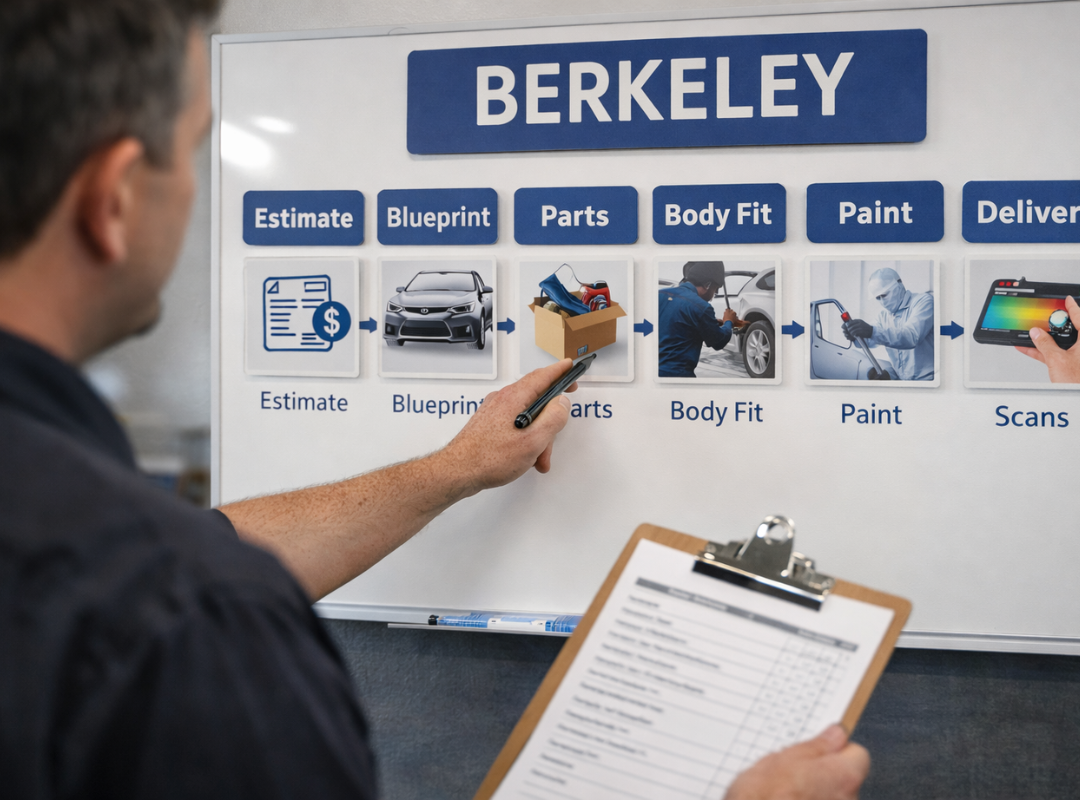
You want real timelines, not guesswork. The honest answer is that every repair is different, but the steps are predictable. This guide walks you through each stage, what usually takes the most time, and how to keep your car moving from estimate to a clean delivery in Berkeley.
Quick answer: Small cosmetic repairs can wrap in a few days once parts and scheduling are set. Moderate hits that need parts, blending, and scans often take one to two weeks. Structural work or vehicles that need specialty parts or multiple calibrations can take longer.
Step 1: Estimate and photo review
We start with photos or an in-person look, then write a clear estimate and flag anything that might be hiding behind the damage.
- If you are opening a claim, the Insurance Information Institute has a plain guide to the process.
- If you want our end-to-end flow, visit Our Process.
What speeds things up: bring your claim number, good photos in daylight, and the best phone or email for updates.
Step 2: Blueprint and approvals
Blueprinting is a short, targeted disassembly around the impact. It confirms mounts, brackets, energy absorbers, and sensor locations before work begins. Fewer surprises means fewer change orders and a steadier timeline.
- Many modern vehicles place driver-assist tech in the bumper or behind grilles and glass. NHTSA’s driver-assistance overview explains why these systems matter for safety and why mounting accuracy is important.
- For a sense of how we plan work, see Our Process — Collision Repair.
Time impact: light scuffs may need little to no blueprint. Corner hits and bumper strikes often need a closer look because sensors live there.
Step 3: Parts ordering and scheduling
Once you approve the plan, we order parts and set your start date based on availability.
- Common items arrive fast. Specialty trim, sensors, camera brackets, or limited-run colors can take longer.
- If you are comparing parts types, we explain options and what your insurer will authorize.
Pro tip: quick approvals keep your spot on the schedule. If a part is delayed, we will offer the next best plan.
Step 4: Body, structure, and test fit
Repair work begins according to the plan you approved.
- We test fit panels, verify gaps and lines, and confirm latch and hinge operation before paint.
- If your vehicle uses aluminum or mixed materials, we follow the correct processes for long-term durability.
- Browse what we do on Collision Repair Services.
Why this matters: catching fit issues now prevents rework later, which saves days overall.
Step 5: Paint, blend, and cure
Color is not a single button. Great matches combine formula data with real-world checks.
- We scan your vehicle with a spectrophotometer, spray small test cards, and adjust until the match holds up outside.
- Most colors look seamless when we blend the new color into a neighboring panel. Training groups like I-CAR explain why blending hides small differences. See I-CAR blending guidance.
- Work happens in a controlled spray booth. The EPA’s refinish rule and the eCFR standard outline why professional shops manage coatings and airflow carefully.
- More detail on our finishing steps is in Our Process — Paint Repair.
Time impact: proper flash and cure windows protect texture and gloss. Rushing here hurts the final look outdoors.
Step 6: Scans, calibration, and QC
Today’s cars rely on cameras and sensors for parking assist, blind-spot alerts, and forward braking support.
- We complete pre and post scans to document system status.
- If the repair touched a sensor zone or the windshield, we coordinate calibration. Some vehicles need static target setups, a short road drive, or both. NHTSA explains the safety side in its ADAS overview.
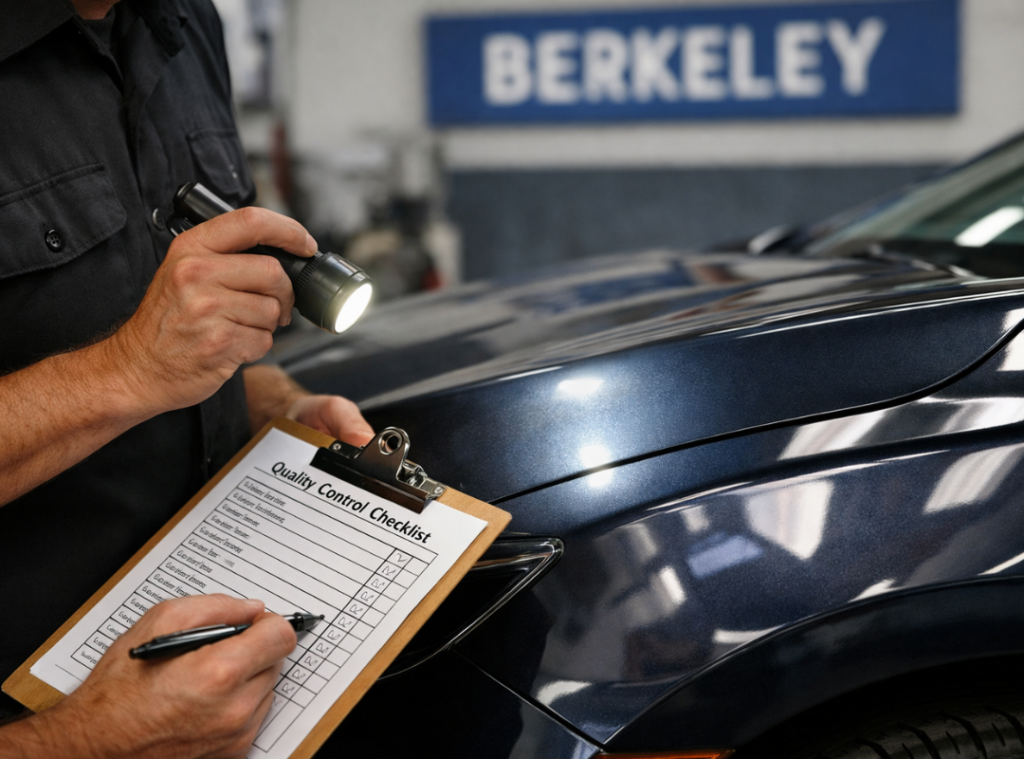
- Final quality control checks panel gaps, finish, lighting, and road feel. IIHS publishes accessible research on how well features reduce crashes. For context, see IIHS front crash prevention.
Time impact: scans are quick. Calibrations add focused time and are worth it because features rely on millimeter accuracy.
Typical time ranges once parts are in hand
Use these as friendly guidelines. Your advisor will tailor a range to your vehicle and plan.
- Small cosmetic repair with a blend: three to five business days
- Corner hit with absorber or bracket replacement: about one to two weeks
- Multiple panels with calibration required: about one to two weeks, sometimes longer based on parts and calibration windows
- Structural repairs or aluminum panel replacement: two weeks or more depending on complexity and verification steps
What slows projects in Berkeley and how to avoid it
- Backordered parts: ask early about substitutes that still meet your goals and policy.
- Hidden damage: blueprinting reduces surprises. If we find more, we explain options first.
- Approval delays: quick responses to estimate updates keep work moving.
- Unplanned calibrations: if you have a bumper or glass repair and any driver-assist features, assume scans are needed and budget time for calibration.
How we keep you in the loop
- You receive a target start date and a realistic completion range.
- We confirm your update preference by text or email.
- If a part is delayed, we send a short status and the next plan.
- At delivery, we walk the car with you in daylight, review paperwork, and answer care questions.
What you can do to save days
- Share clear photos during the estimate stage
- Approve the plan as soon as questions are answered
- Provide claim details and check the app for insurer messages
- Choose the Berkeley location closest to you for faster drop off and pickup
FAQs
Why does blueprinting help the timeline
It confirms what is broken behind the scenes so we order exactly what is needed. Fewer supplements mean steadier timelines.
Do I need calibration for a simple bumper repaint
Not always. If sensors or brackets were removed or replaced, calibration is usually required. A quick scan tells us what the system sees.
Can I get the car back between stages
If it is safe to drive and work has not begun, we can schedule around your needs. Once work starts, moving straight through is fastest.
Will insurance cover calibration
If the manufacturer requires it for your repair, calibration is typically covered. We include photos and scan results to support approvals.
Ready for a clear timeline and a clean delivery
Start with an estimate at the Berkeley location that fits your day. We will give you a realistic range, explain each step in plain language, and keep you updated through delivery.
👉 Book in Berkeley: Durant Ave • North Berkeley • Central Berkeley
Learn how we work in Our Process and browse services on Collision Repair Services.