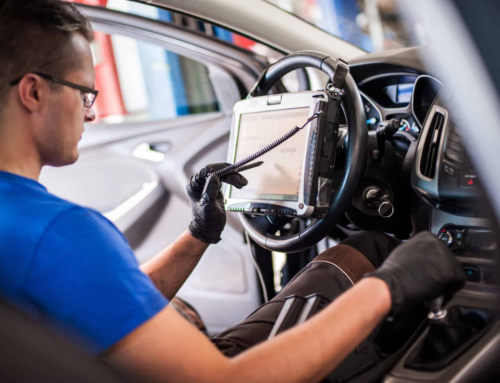

Color match starts with your vehicle’s color code, then a spectrophotometer scan and spray-out tests refine the formula. The new color is applied to the repaired panel, then blended into adjacent panels so the eye cannot find an edge. This work happens in a temperature controlled spray booth for consistency and dust control.
- What that looks like in our shop: Our Process — Paint Repair
- Full services overview: Collision Repair Services
- Choose the Berkeley location that fits your day: Durant Ave, North Berkeley, Central Berkeley
Step 1: find the color code and confirm the variant
Every car has a factory color code that narrows the formula. It is often located on a door jamb label or under the hood. Modern colors have variations based on plant or batch. Refinish training groups explain how shops chase those variants rather than stopping at a single code. See I-CAR on color matching and variants and I-CAR on color identification basics.
Step 2: scan with a spectrophotometer
A spectrophotometer reads how your existing paint reflects light. That scan suggests a starting formula, which we fine tune with test panels. If you want a deeper dive on the tool and why it improves match consistency, skim I-CAR’s spectrophotometer overview.
Step 3: create spray-out cards and adjust the formula
We spray small cards to see color, metallic orientation, and pearl effect under different light. Conditions matter. That is why refinishing happens in a spray booth that controls airflow, temperature, and dust. The EPA’s automobile refinish rule explains why professional shops manage coatings and emissions carefully. See EPA: Automobile Refinish Coatings VOC rule and the eCFR refinish standard.
Step 4: blend into adjacent panels
Even a perfect formula can shift visually at an edge. That is why refinish technicians blend the new color into a neighboring panel so there is no hard line. Training resources show how blending hides small differences in flop and metallic laydown. Learn more in I-CAR’s blending guidance.
Where we blend most often
- Front bumper into fenders
- Fender into the door
- Quarter panel into the door
- Rear bumper into quarter panels
Step 5: clearcoat and cure for long term gloss
Once color is blended, we apply clearcoat to protect the finish and lock in gloss. Proper flash times and booth temperature keep texture consistent with neighboring panels. You can preview these steps in Our Process — Paint Repair.

Berkeley checklist for a repair that looks factory
- Ask to see the color code and confirm whether your color has known variants
- Request a spectrophotometer scan plus spray-out cards before the final application
- Confirm where the blend will happen so panel edges are invisible in daylight
- Verify a controlled spray booth and the use of a spectro based color match system
- Inspect outdoors at delivery, not only under shop lights
Myth versus fact
Myth
A computer finds one formula and that is it.
Fact
Color codes have variants and paint ages differently in sun and weather. A spectrophotometer and spray-outs bridge that gap.
Myth
If the color code matches, blending is optional.
Fact
Blending is the proven method for an invisible transition on metallic and pearl colors. See I-CAR on blend strategy.
Myth
Clearcoat brand is the only thing that decides gloss.
Fact
Booth control, flash times, and gun setup drive texture and gloss uniformity just as much as the product itself.
Frequently asked questions
Where is my color code
Many codes are printed on the driver door jamb label or an underhood decal. If you are not seeing it, our team will look it up by VIN.
Why do some reds and pearls look different at angles
Pearl and metallic particles change appearance with viewing angle. That is why technicians evaluate color in both straight on and flop positions and blend into adjacent panels.
What about plastic parts like bumpers
Plastic flex and heat can affect how metallic lays down. We adjust technique and often blend onto the adjacent metal panel for a seamless result.
Can I see the test cards
Yes. Ask to see the spray-out cards. We are happy to show how we dialed the match.
Why choose a Berkeley shop with process and training
You can tour how we sequence paint and finishing in Our Process — Paint Repair. For collision end to end steps, visit Our Process. When you want an estimate, choose the location that fits your schedule: Durant Ave, North Berkeley, or Central Berkeley.
Ready to make your repair invisible
If you want a repair that passes the daylight test on San Pablo Avenue or near the UC campus, start with a quick estimate. We will show you the color code, the scan, the spray-outs, and the plan to blend panels for a seamless finish.
👉 Book your visit: Durant Ave, North Berkeley, Central Berkeley